

Dial 1975 review: Boriyat ke liye khed hai
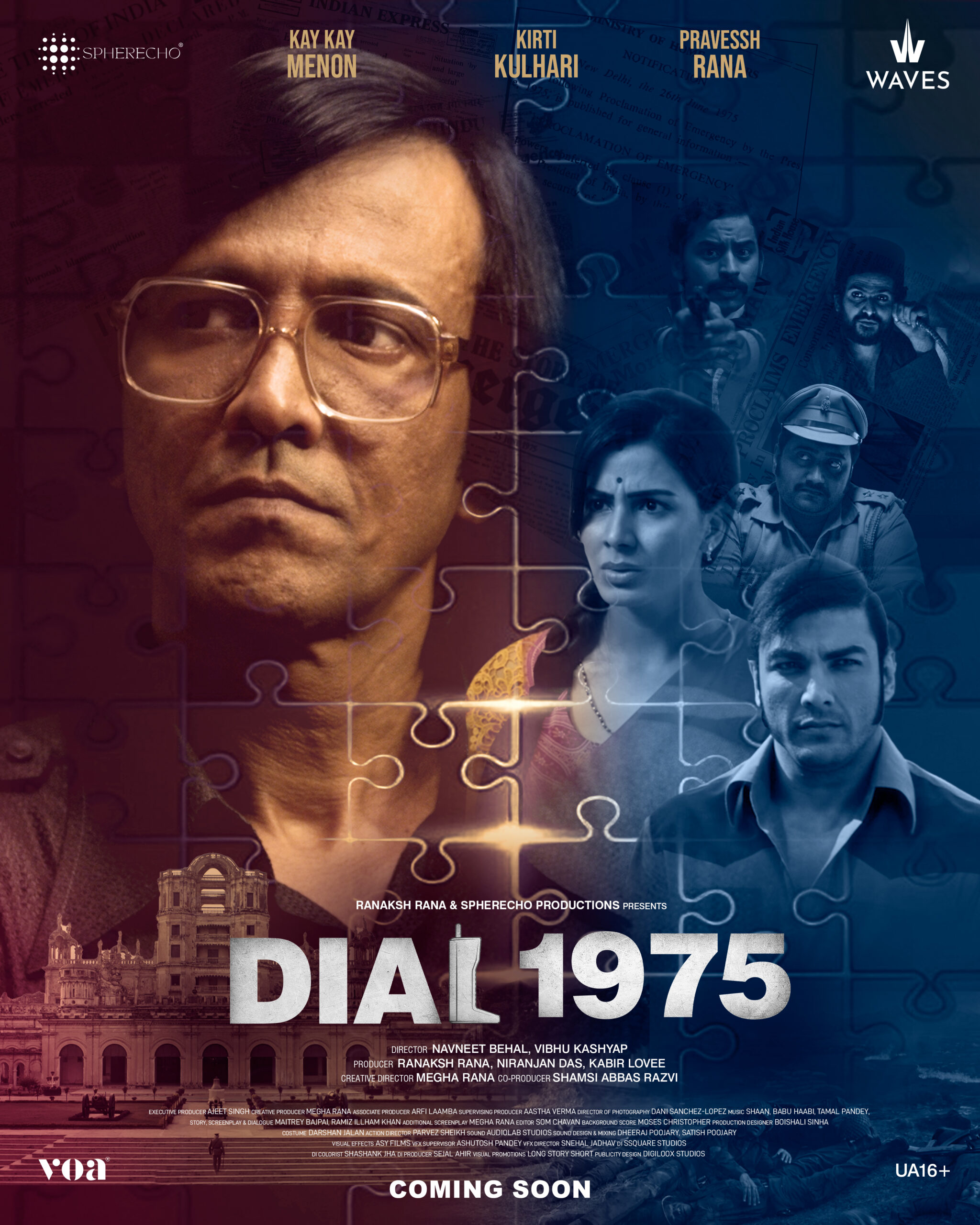
A narrative built around the talk of India’s first mobile phone prototype is nothing but a dangling hook to draw audiences toward its subtle political messaging. Kay Kay Menon and Kirti Kulhari’s talents feel wasted in this silly thriller.
Rating: 
 (1.5 / 5)

By Mayur Lookhar
The telephone would perhaps be considered the most useful invention of the 19th century. We have Alexander Graham Bell to thank for it. In the 20th century, apart from the computer, the mobile phone could be considered a world-changing invention. First conceived in 1973 by Motorola engineer Martin Cooper, the first handheld mobile phone was called the DynaTAC 8000X. It became available to the public in 1983. In India, the cellular phone arrived in 1995.

For a cinema portal, why are we discussing telephones and scientific inventions? We have a Bollywood film called Dial 1975. Its trailer intrigued us because it mentioned the first mobile phone in India – or possibly a prototype. Given the plotline, it is only natural that such a film found its way onto Waves OTT, the digital platform of Prasar Bharati.
Conceived and written by Megha Rana, Dial 1975 (2026) is helmed by little known filmmakers Navneet Behal and Vibhu Kashyap.
Story
Set during the Emergency, Dial 1975 follows Govind (Kay Kay Menon), a former soldier turned rebel and criminal, and Prakash (Pravessh Rana), a convicted criminal from Uttar Pradesh. The two cross paths during a common trail involving a RAW agent, an influential figure, and a secret deal concerning a wireless cellphone smuggled from Germany. Meena (Kirti Kulhari), a government official, is also drawn into the trail and backs Prakash in the hope of sharing the spoils.
Screenplay & Direction
The trailer, in particular its mention of India’s first cellphone—or a prototype—lulls you into thinking that this may be a film attempting to uncover an unknown fact, celebrate an unsung hero, or explore an untold *Made in India* story. Regrettably, however, Dial 1975 turns out to be something else, with the talk of India’s first mobile phone serving merely as a dangling hook to draw audiences towards its subtle political messaging. Over the years, the Emergency period (1975–1977) has been exploited for institutional interests, and with Dial 1975 arriving on the national broadcaster’s OTT wing, one might expect it to carry a subtle agenda.
Much to our disappointment, the mobile-phone connection and the film’s agenda take ages to emerge, leaving viewers to wonder what is really going on. The film simply meanders along aimlessly until the story begins to take shape. Perhaps the wireless cellphone is being used metaphorically to condemn the suppression of speech and the dismissal of civil rights. Imagine if cellphones had been available to the public, political adversaries, or rebels-would the establishment of that time have been able to continue with the Emergency? Beyond this metaphorical interpretation, there is little to the story; the dull screenplay saps the viewer’s energy every few minutes. Just as a new invention can be riddled with interruptions, we are compelled to say: “Rukawat nahi, boriyat ke liye khed hai” (Sorry for the boredom).
Acting

The film opens with a shot of a badly wounded Govind (Kay Kay Menon) struggling to get back on his feet during the 1962 Sino-Indian War. For a moment, we are reminded of Kay Kay’s brutal fate in *Haider*, in which his character loses his limbs in a blast and crawls with the little life left in him. Thankfully, Menon suffers no such fate here. However, the soldier loses his composure when he sees his colleagues firing at a local girl. He gets up and shoots all of them. Naturally, a court-martial follows. Rather surprisingly, 13 years later, Govind is a free man, now described as someone who has turned into a devil. During his trail, he enters a house, first savors the delicious food prepared by his target’s wife, and then kills the man, followed by the wife and their daughter. Phew! There is simply no explanation for this radical transformation in a former soldier. Kay Kay, however, never once lets the weak script dent his confidence, as the seasoned artiste delivers another competent performance.
Bigg Boss-fame artist Pravessh Rana makes another attempt to find his feet as an actor. After appearing listless in his earlier films, the brawny Rana finally makes a decent impression. Both Rana and Menon sport 1970s hairstyles, with the former even sporting Elvis Presley’s famous sideburns. Rana, however, looks more like former WWE wrestler The Honky Tonk Man than Presley.

For a film set during the Emergency – a period when civil rights were suspended, it is surprising that the leading characters in Dial 1975 operate with such absolute freedom in going about their goals. Given his six-pack physique, a testosterone-heavy stud like Prakash roaming around freely without attracting the attention of the forced-sterilization squads is baffling.
One is surprised to see the late Tom Alter, which naturally points to the fact that Dial 1975 was shot before 2017 and lying in the cans since then. Alter’s cunning cop character called Irish is a conveniently placed villain, one who reminds, that no matter who rules Delhi, the IIrish-men will always survive.

You cannot help but feel for the talented Kirti Kulhari, who seems wasted in yet another poorly film. Amid the film’s sophisticated leading characters, the directors find space for two rooted teenage criminals, Kannu and Mannu, from Jahangirabad. Imagine that, of all people, the DynaTAC 8000X handset falls into the hands of these brothers, who clearly have no idea what it is. Danish Khan and Muaz Hassan Rai, however, make quite an impression as the daring teenagers from Buland Shahr.
Technical Aspects
Technical expertise counts for nothing when the story fails to connect on an emotional level. Despite its 121-minute runtime, the dull drama feels exhausting, compounded by the excessively dramatic background score. Cinematographer Dani Salo, however, has earned his stripes by capturing some fine visuals. The penultimate sit-down drama in a hotel conference room is neatly captured by Salo.
Final thoughts
Sitting through 121 minutes of Dial 75 felt exhausting. Two things, though, linger in our mind. Perhaps, for the first time, is how a cell phone serves as narrator in a film. The other being how, in the Jehangirabad hotel, Kirti Kulhari’s Meena wonders – it’s strange how room no. 1993 is facing room no. 2002. Well, we do know the events of Mumbai 1993 well, but the 2002 reference is perhaps a surprise, and in conflict with an institutional interest of today. However, the final narration in the film, without naming Mrs. Indira Gandhi, reminds us all that in a true democracy, there is no place for autocracy. Today, there is no Emergency, but India faces similar social and political challenges. The recent youth-led protests are perhaps a new wave coming. Will it be Dial 2029, or ek aur baar Modi sarkar?
Dial 1975 will stream on Waves OTT from 21 August at 12.00 pm.
Video review below.