

7 Dogs (Hindi) review: Bond-like ambition, Bollywood-like execution
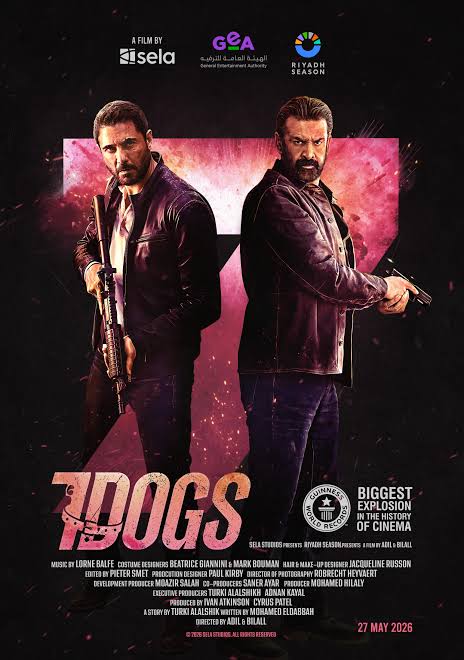
Saudi Arabian action film appears to ape Hollywood action thrillers, but perhaps forgets it own roots. Though silly, the cameos by Salman Khan and Sanjay Dutt are likely to be the main attraction for desi audiences.
Rating:  (2 / 5)

By Mayur Lookhar
Last year, we had the privilege of watching our first Saudi Arabian film, Mansour Assad’s fine dark comedy Slave (2025). This year, we watched our second, 7 Dogs (2026) – quite possibly Saudi Arabia’s first international action thriller. Featuring cameos from Bollywood stars Salman Khan and Sanjay Dutt, it’s bound to spark curiosity among desi viewers.
Firstly, the title itself is intriguing because dogs are generally perceived as culturally insignificant in many Islamic nations. Throw in rap music, and you realize how, much like its establishment, Saudi cinema, too, is becoming increasingly liberal.
7 Dogs is helmed by Bad Boy franchise fame of Adil El Arbi and Bilall Fallah. This is a story conceived by Turki Alalshikh, head of Saudi Arabia’s General Entertainment Authority and an adviser at the Royal Court with the rank of Minister. Turki wears many hats. He is also a key co-founder of Zuffa Boxing. He previously owned Egyptian football club Pyramids FC from 2018 to 2019 and Spanish outfit Almería from 2019 to 2025. Given his massive political clout and high-stakes sporting background, 7 Dogs naturally arrives with grand, high-octane ambition, and at $40 million, is said to be Saudi Arabia’s most expensive film so far. Turki’s story is turned into a screenplay by Mohamed El-Dabbah.
Given how several Middle East nations, including Saudi Arabia, have banned a few Indian patriotic action thrillers in recent years, should we Indians really warm up to the land of Mecca’s first global spy action thriller-comedy? Well, we Indians do have big hearts and an undeniable soft spot for the genre.
Story
7 Dogs opens with a daring airborne action sequence where Interpol agent Khalid Al-Azzazi (Ahmed Ezz) battles Ghali Abu Dawood (Karim Abdel Aziz). After miraculously surviving the turbulent flight, they crash land in Saudi Arabia, where Dawood is immediately taken into high-security custody. Khalid and General Nasser (Nasser Al Qasabi) offer Ghali a deal: help them expose 7 Dogs – a global crime syndicate he once belonged to before quitting when they turned to drug trafficking. As the lone insider who can lead Interpol to the syndicate, Ghali becomes their ticket to dismantling the network. The globe-trotting narrative moves across China, India, and the USA before culminating in the desert, with Khalid discovering a personal motive along the way to bring 7 Dogs to justice.
Screenplay & Direction
Both Slave and now 7 Dogs share a mysterious drug sub-plot. In 7 Dogs, society is plagued by ‘Pink Lady – a potent drug that proves fatal in no time. Having Interpol at the helm naturally allows the narrative to travel across the globe. 7 Dogs grips you early with a fairly well-crafted opening hour. However, directors Adil and Bilall make a mess of the final 65 minutes, where it becomes increasingly evident that the film is simply trying to ape Hollywood spy action thrillers. It displays Bond-like ambition, only to end up mirroring a subpar Bollywood spy flick. One must not forget, one of the producers here is a Cyrus Patel. While the 7 Dogs (drug lords) are stationed across different nations, the screenplay operates on a repetitive loop: Ghali, Khalid and his two female accomplices land in hostile territory, take down a local kingpin and his/her henchmen, and promptly move to the next target. This formulaic structure leaves little room for emotional connection, turning the film into nothing more than a series of relentless action set pieces.
Global scale and global appeal are all fine, but 7 Dogs perhaps forgets its own roots. Is there a genuine Saudi connection here? While the people of the Kingdom are best placed to judge, barring the language, the film strikes you as just another generic spy action thriller. It’s fine to be liberal, but culturally speaking, this drama is likely to feel distant.
Acting

Most of the leading Arabic cast members are Egyptian artists, with Nasser Al Qasabi standing out as a local Saudi talent. While watching a dubbed version is never a fair way to judge international actors, Ahmed Ezz possesses a striking screen presence , one that is bound to win him female admirers globally. Khalid’s personal life brings a touch of intrigue: here is a man set to marry his beloved Rabab (Hana El Zahed), but his high-stakes job constantly threatens to derail the wedding. Early on, he is torn between his mother Sarah (Menna Shalabi) and his fiancée, and their differing choices. These family dynamics add a touch of relatable emotion, helping humanise his character.
Ghali Abu Dawood, however, is the more complex character, one with a dark sense of humor, always ready to crack a joke in the middle of a life-or-death crisis. At 51, the heavy physical action perhaps proves to be too much of an ask for Karim Abdel Aziz. Both leading men try hard, but their efforts are dragged down by a predictable plot and a cliché-ridden screenplay.

It is the female leads who truly command attention here, effortlessly exuding that classic Bond-girl swagger. As Khalid’s tactical partners, Tara Emad and Sandy Bella dive headfirst into the action, constantly covering for the men and bailing them out of life-threatening scrapes. In fact, they bring far more agility to the screen than both Ahmed Ezz and Karim Abdel Aziz combined. Doing all this while sporting the most stylish western outfits.

Then there is global crush Monica Bellucci, who makes a stylish impression as Giulia Leone – a key figure of the syndicate, and one handling the lethal Pink Lady drug pipeline. But why the surname Leone? It feels like a subtle homage to legendary Italian filmmaker Sergio Leone, a pioneer of Western spaghetti.
Breaking Bad’s iconic baddie Giancarlo Esposito plays Roman Marks, one of the primary drug lords. Interestingly, reports surfaced during filming for 7 Dogs that the actor embraced Islam, which might earn him a few extra brownie points with local audiences. You do wonder, though, whether the gifted actor is simply being stereotyped into yet another drug lord role.

And what about our desi superstars? Unfortunately, Salman Khan and Sanjay Dutt bear the brunt of poorly etched characters. Khan’s Johar Bhai helps Khalid and Ghali track down and eliminate Dutt’s bizarre drug lord, Ranjit Kapoor. Well, Khan drops the Saudi guests in an auto. In the dubbed Indian version, both stars naturally deliver their lines in Hindi. With Salman, performance is always about his mood. Regrettably, the one we see in 7 Dogs feels disengaged. Though the voice belongs to Salman, the delivery is so flat that it almost sounds like a dubbing artist impersonating his style. As for Dutt, he is insufferable as Ranjit Kapoor, a crime lord who rather bizarrely live-streams his life on camera. As a ‘Ranjit’, he naturally lusts after women, but what is with his bizarre gluttony? He is literally lured into an Interpol trap using a Belgian chocolate vending machine. Just hearing Johar Bhai remark, ‘Ranjit simply loves eating,’ makes you wonder whether the makers of 7 Dogs are taking a sly jab at the Indian bureaucracy – hardly a business-friendly system, and one with a long history of kickbacks.
Technical Aspects
Where 7 Dogs genuinely excels is in its technical craft, thanks to DP Robrecht Heyvaert and editor Pieter Smet. The camera work is relentlessly inventive: an ambitious action sequence tracking up from under a glass floor in China gives way to an aggressive, in-your-face visual style action during the India stretch. Culminating in a high-octane desert finale packed with ATVs and roaring luxury supercars, the sequence delivers an undeniable visual thrill.
Final thoughts
Having reopened cinemas in 2018, the Kingdom of Saudi Arabia appears eager to project a modern, liberal image to a world that long perceived it as deeply conservative. The nation possesses a rich history, yet it seems to be relying more on imported talent/tropes to revive its cinematic culture. With vast oil wealth, world-class infrastructure, and lucrative subsidies, Saudi Arabia will easily attract global filmmakers. Going forward, however, one hopes to see more homegrown talent and, more importantly, authentic local stories. Just aping the West to prove liberalism, is no smart cinema. The 7 Dogs serve their purpose, but the region already possesses the timeless magic of Arabian Nights – why not back some of those fabled stories in a new-age avatar, manufactured not by imported hands, but recreated by the sons and daughters of the soil.
Video review below.