

Why Bollywood Is Losing Its Magic: An Insider’s Honest Wake-Up Call
There was a time when Friday mornings carried an electricity you could almost touch. You’d stand outside a single-screen theater or an early multiplex show, hear the roar of the crowd at the opening credits, and lose yourself for three hours. Hindi cinema wasn’t just an industry; it was our emotional home. It gave us our anthems, our heartbreaks, and our heroes.
Today, walk into a cinema hall on a regular weekend afternoon, and the silence is deafening.
Despite the aggressive PR campaigns and claims of hundred-crore clubs, anyone working close to the ground knows the reality: Bollywood is in the middle of a massive slump. Audiences haven’t abandoned cinema—they’ve simply abandoned the formula Bollywood refuses to let go of.
Here is an honest breakdown of why the magic is slipping away, backed by what the audience and the data are actually telling us.
1. The Numbers Don’t Lie: Audiences Are Staying Home
For the past couple of years, trade analysts have tried to paint a sunny picture using inflated box office grosses. But if you look behind the curtain, the real story is footfalls—the sheer number of human beings buying a ticket and sitting in a seat.
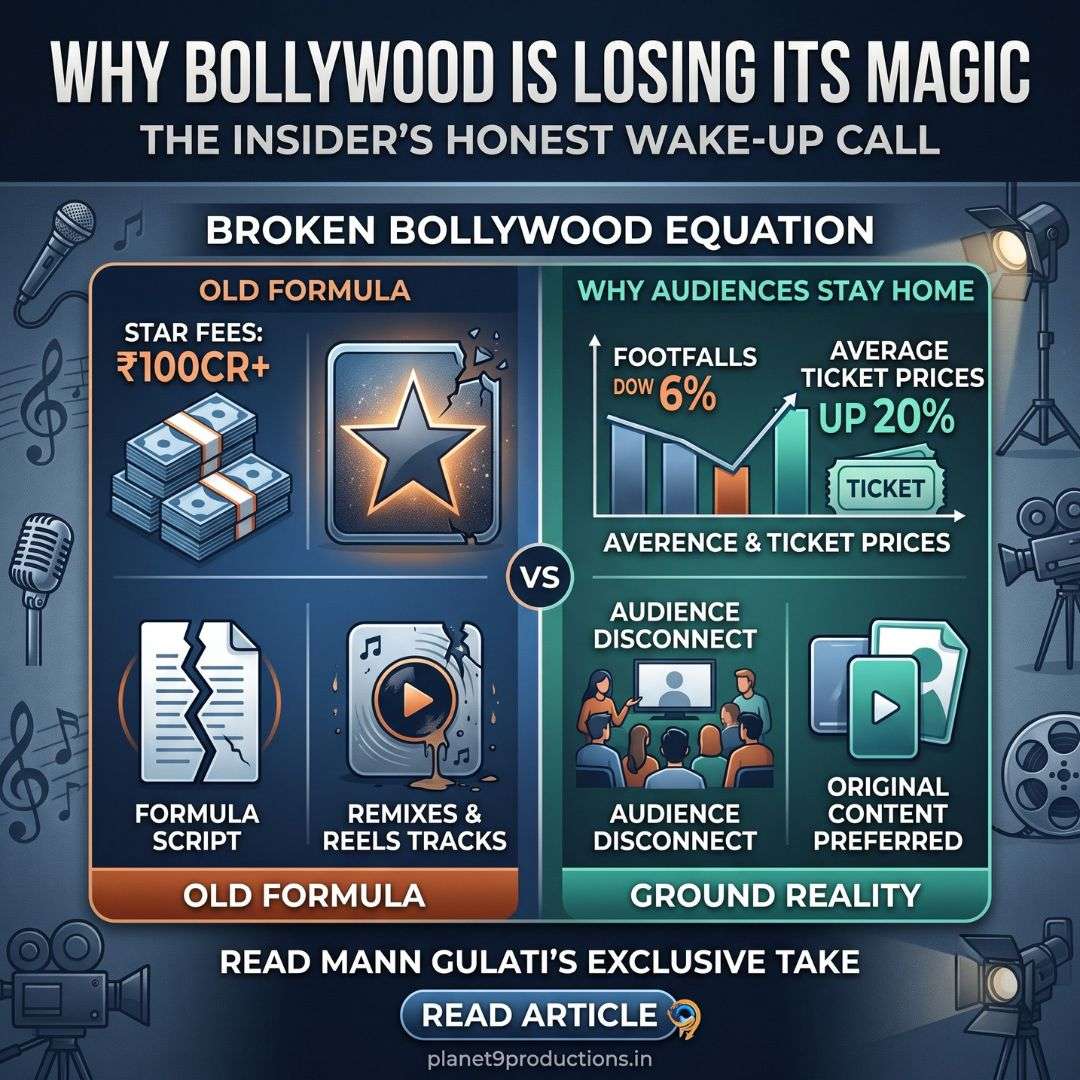
According to The Ormax Box Office Report, Indian cinema saw theatrical footfalls drop by 6% in 2025, settling at just 83.2 crore admissions. So why did some revenue figures look stable? Because multiplexes jacked up Average Ticket Prices (ATP) by nearly 20%.
When a family of four has to spend ₹2,500 on tickets and popcorn, a film cannot just be “timepass.” It has to be an event. Instead of making movies worth that investment, Mumbai studios simply asked fewer people to pay more money to cover their bloated budgets. That model was never going to last, and now the cracks are impossible to ignore.
2. The Star Era Is Officially Over
For decades, putting an A-lister on a poster was an insurance policy. A massive star guaranteed a packed opening weekend regardless of whether the script had a coherent second half.
That safety net is gone.
According to Ormax Media’s study on box office concentration (The Resurgence of the Long Tail), the revenue share commanded by the top 10 star-driven tentpoles fell from 41% down to 33%. Meanwhile, audiences rewarded rooted, concept-heavy films like 12th Fail, Munjya, and Stree 2.
Viewers are sending an unmistakable message: We don’t care about your ₹100-crore star fee. Give us a story.
When regional industries like Malayalam, Tamil, Telugu, and Punjabi cinema are delivering raw grit, fresh concepts, and tight writing on modest budgets, Bollywood’s reliance on aging formulas and synthetic star power looks completely out of touch.
3. The Death of the Soulful Melody
As someone who lives and breathes music, this is perhaps the deepest wound.
Historically, Bollywood didn’t just tell stories with music—the music carried the culture. A great album could pull audiences into theaters weeks before release and keep songs alive in people’s car stereos for three decades.
What do we have now?
- Endless, uninspired remixes of 90s classics that nobody asked for.
- Corporate-approved tracks engineered specifically to be 15-second background audio for Instagram Reels.
- Cookie-cutter hooklines with no lyrical depth, no emotional lingering, and zero cultural identity.
According to the EY-FICCI Indian Media & Entertainment Report, while digital music streaming is exploding across India, consumption is shifting aggressively toward independent artists and regional sounds—Punjabi, Haryanvi, and South Indian tracks. Bollywood has outsourced its musical soul to algorithms, and people have simply tuned out.
4. Urban Echo Chambers vs. Rooted India
Bollywood has developed a geographic blind spot. Too many scripts are greenlit in air-conditioned Bandra offices by creators who consume mostly Western prestige television and live in an urban bubble. The characters speak an awkward blend of English and Hindi, grapple with hyper-niche dilemmas, and exist in sleek, plastic worlds that feel alien to 90% of the country.
Look at the films that become genuine cultural phenomenons—they smell of the soil. They feature local dialects, middle-class anxieties, genuine folklore, and unfiltered humor. Cinema has to belong to the audience before the audience will claim it as their own.
The Road Ahead: How Hindi Cinema Reclaims Its Soul
Bollywood isn’t dying, but its old playbook is dead. The audience has matured, grown sharper, and found better alternatives. To win them back, creators need to stop copying the past and start taking real risks:
Cut the vanity, fund the script: Rebalance budgets so money shows up on the screen and in writer rooms, not just in vanity vans.
Trust original composers and lyricists: Stop treating music as marketing collateral. Let musicians compose from the heart again.
Step outside Mumbai: Tell stories rooted in small towns, tier-2 cities, and raw subcultures with unapologetic authenticity.
The magic hasn’t vanished into thin air. It’s just waiting for storytellers brave enough to respect the people sitting in the dark.
By Mann Gulati
Why Bollywood is failing, Bollywood box office decline, Mann Gulati, Bollywood music downfall, Indian cinema audience trends, Hindi film industry reality.