

Main Vaapas Aaunga review: In search of truth and closure
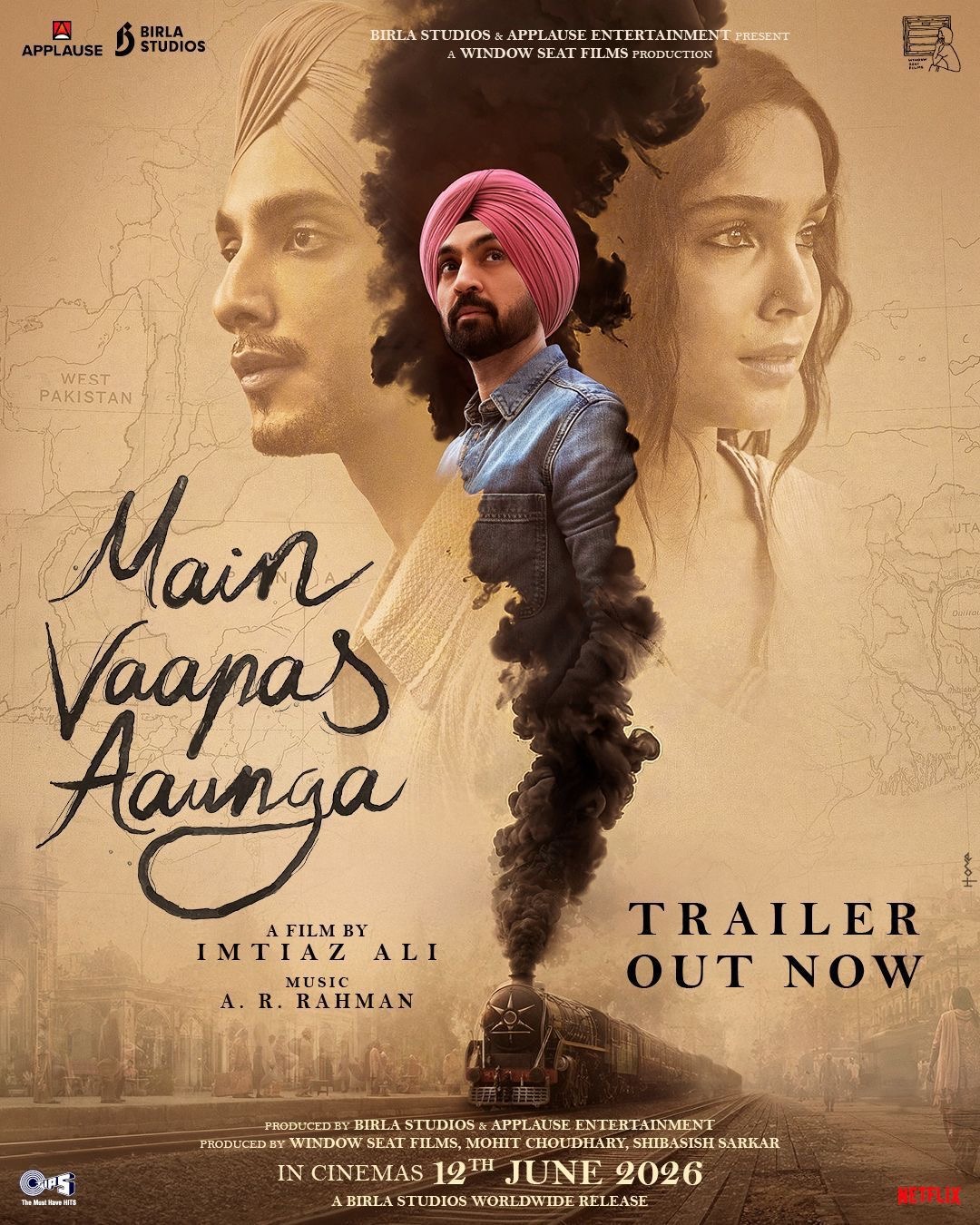
For the first time, an Imtiaz Ali film goes beyond the agony and pain in one particular romantic relationship to inevitably reflect the pain of a family.
Rating:  (3 / 5)

By Mayur Lookhar
Main Vaapas Aaunga – no, this isn’t Arnold Schwarzenegger’s famous “I’ll be back” line from Terminator (1984). It’s more closely reminding us of the classic Sandese Aate Hain song from Border (1997) where, in the final verse, a soldier makes a promise to his dear ones that he’ll be back home. Nearly 30 years later, Imtiaz Ali has titled his film Main Vaapas Aaunga, a love story set in the time of Partition.
Ah, where do we begin? Here is a family where everyone, bar the grandson, has given up on the 95-year-old patriarch who has dementia. The grandson consults his old uncle Pali (Satnam Singh) to help shed some light on what grandpa has been holding onto. Pali urges the family not to bother, as some secrets will die with Ishar Singh Grewal. Nirvair then quips, “What if that doesn’t happen and that hidden pain is also passed on to our generation?” Nirvair seeks the truth and hopefully a closure for Ishar.
Story
95-year-old Ishar Singh Grewal (Naseeruddin Shah) wakes up one morning and instructs his driver to take him to his home in Sargodha. The puzzled driver reminds him that the family home is here in Amritsar. The old man, though, wouldn’t listen. At the Attari border, BSF official Keshav Parman (Kumud Mishra) informs the old man that Sargodha is now in Pakistan post-Partition, but the old man shoots back, “What? When did this Partition happen?”
His wish unfulfilled, the old man soon suffers a stroke, which then only aggravates his dementia. His sons and daughter-in-law all have given up on the old man, but his grandson Nirvair (Diljit Dosanjh), who arrives from London, senses that maybe there is something his grandfather is hinting at, and he’s determined to find it.
Screenplay & Direction

Separation, parting – Imtiaz Ali films largely centre around such themes, but it would be wrong to use the word template, as that would be disrespectful to each character and narrative. For the first time, an Imtiaz Ali film goes beyond the agony and pain in one particular romantic relationship to inevitably reflect the pain of a family. Partition is a subject that’s been explored countless times, but Imtiaz Ali brings his humane touch to the tragic past – not to fan any flames of revenge, but to shed light on the destruction that such a tragedy leaves behind. Ali and his co-writer Nayanika Mahtani do so without really getting into the political side of it. Irrespective of which side of the border you are on, the film grieves for the innocent lives lost and the millions afflicted by Partition. The British, however, aren’t spared, but Ali doesn’t resort to any cussing. Instead, he infuses humour into these conversations to drive home his point. We reckon that descendants of Lord Mountbatten and Sir Cyril Radcliffe will acknowledge Ali’s point. There is also subtle dig at Hitler too.
Main Vaapas Aaunga is a poignant story, backed by a fairly neat screenplay, but the first half feels slightly stretched. Thereafter, it picks up momentum, and now having defined a purpose, the film naturally intrigues and engages more. There is closure for Ishar and the Grewals, and Ali ends the 166-minute film by dropping real visuals of refugees, both local and international, which only adds to its global appeal.
Acting

Albeit fictional, the beauty of Main Vaapas Aaunga is how two respected Muslim gentlemen are at the forefront of telling a story about the pain of partition through the eyes of a Sikh family. For all his experience, playing this character surely came with its challenge and Naseeruddin Shah embraces the pain, the despair of Ishar Singh Grewal convincingly. Given his age and dire condition, maybe Shah displays unprecedent anxiety in certain scenes, but only cinema can create such an experience. While one is empathetic towards Ishar’s feelings for Afsana Ahmedzai aka Jiya, one is also bewildered by the obscurity around Ishar’s wife. Since migrating to Amritsar, Ishar is said to have lived a tough life; his past traumatic experiences made him less emotionally connected to his wife and children. For Ishar, refugees simply have no space and time to grieve. Is that how it is for most such families?
Though a dud, Vedang Raina showed promise in Jigra (2024), and that perhaps convinced Imtiaz Ali to place faith in the young man for such a pivotal role – playing the younger Ishar who was fondly called Keenu by loved ones. The trailer raised concerns over Raina and Sharvari’s pairing. It’s not the 3-year age difference per se, but the wiry Raina looked more like a younger brother than a partner to Sharvari. More worryingly is the lack of genuine chemistry.

Sharvari, too, was a bold choice to play the Urdu-speaking love interest of Keenu. Ali taps into Sharvari’s screen presence, but is it a career-defining role? Given the period and the place, a love affair between a Sikh boy and a Muslim girl ought to be guarded, but Keenu is mostly lost, speechless in the few private conversations. You question how Jiya, a socialist and part of a progressive writer’s group in college, fell for the wiry Keenu. The few times they make an impression are in an individual capacity. Sharvari pleasantly surprises with her Urdu speech in her college fest. She is hesitant to begin with, but the moment Keenu arrives, she loosens up. You are under the impression that this is perhaps the first time the duo is seeing each other, but shortly you learn that they are a couple. Together, their screen time was limited, but Raina and Sharvari don’t quite convince as a pair. For all the posturing, eventually a viewer is more likely to feel emotionally connected with the women in the Grewal house than with Keenu’s sad love story with Jiya.
In Sikhism, Nirvair stands for one with no hatred, no enemies, and Diljit Dosanjh’s Nirvair imbibes those qualities. He is a confused man, though, having quit his third job in a year, and non-committal in his relationship or friendship with Kaveri (Banita Sandhu). He tries his hand at stand-up comedy, but within minutes, Londoners begin to leave. You wouldn’t bet on such a man to understand his dying grandfather, but once back home, he is the only one who senses that Ishar is trying to say something deep. From the confused Londoner, Nirvair turns into this wise, confident Punjabi who is determined to help his grandfather get closure. Ali brought out the best in Dosanjh, the actor in Amar Singh Chamkila (2024), and Dosanjh continues that good form with Main Vaapas Aaunga.
Usually, partition subjects are filled with rage, bloodshed, Ali though stays clear of Pakistani bashing. For him, and the good socialists of Sargodha, religious politics was confusing. He refers to the rioters as Martians, because until they arrived Sargodha was a place of communal harmony. Afzal (Danish Pandor), the chief rioter, too, isn’t all evil to begin with. He cautions Keenu, his family and other Sikhs to leave the land before things get ugly. It’s only when the bodies of his ilk arrive in train in retaliatory killings, that Afzal leads a mob to the Ahmedzai bungalow.
Rajat Kapoor and Manish Chaudhary are impressive as Iqbal Grewal and Muzaffar Ahmedzai, respectively. Without revealing much, Dolly Ahluwalia, who plays Keenu’s grandmother, shakes you with her display.
Music and technical aspects
Imtiaz Ali, A.R. Rahman, and Irshad Kamil – this troika generally creates soulful music. Given the somber nature of this story, the trio produces a right mix of fun, plus a few ballads. Maskara and Ishq Mastana are fun tracks rooted in culture, while Kya Kamaal Hai, though joyful in tune and tone, actually reflects the plight of refugees.
Ali’s films carry a strong visual appeal too. Sylvestre Fonseca (cinematography) and Suman Roy Mahapatra (production design) help to bring out that vision effectively.
Final thoughts
Partition tales have been plenty, but Ali’s Main Vaapas Aaunga is admirable for its larger human-interest message – that home is where the heart is. It sensitises the youth to the tragic events of 1947, but without preaching and in a refreshing, non-resentful way. Its heart silently beats for many refugees across the globe. Not all despair and displacement arise out of new borders, but hopefully, Main Vaapas Aaunga will also make some internal powers rethink bulldozer politics. It takes years, blood, and sweat to build a home. Whether it’s rioters or the establishment, how cold are you to not think twice before displacing people and demolishing homes? You can break bricks, hearts, but never erase memories.
Video review below.