

Bharat Bhhagya Viddhaata review: ‘Cama’ deviyan to the rescue
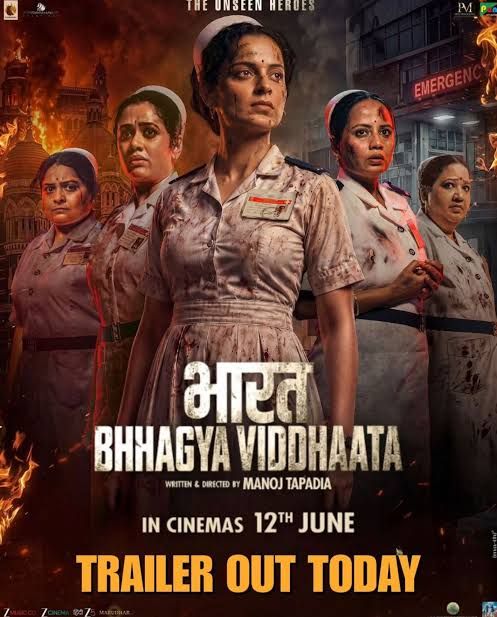
Actor-producer Kangana Ranaut and her team pay a fine tribute to the unsung nurses of Cama Hospital, who helped save over 400 lives during the 2008 Mumbai terror attacks.
Rating:  ( 3 / 5)

By Mayur Lookhar
Bharat Bhagya Vidhata! Beautiful words that play in our national anthem. They mean “dispenser of Bharat’s destiny.” As a mark of respect, Prime Minister Narendra Modi dedicated these words to India’s labour force. How appropriate that this would also be the title of Kangana Ranaut’s film.
Based on the heroic acts of nurses from Cama Hospital during the 2008 Mumbai terror attacks, Bharat Bhhagya Viddhaata (2026) hopes to pay tribute to these unsung heroes. About 15 nurses, and few other staff, didn’t care for their lives; instead, they used their quick thinking to prevent Pakistani terrorist Ajmal Kasab and his accomplice from wreaking havoc in the government hospital, thus saving over 400 lives.
Maybe safety concerns prompted the then mandarins to keep the identities of these nurses hidden. But nearly 18 years have passed, and honestly, how many of us were even aware of their names? Yours truly is guilty here too, and so, to begin with, we’d like to salute these unsung nurses. As recently reported, prominent among them were Anjali Kulthe, Meenakshi Musale, Laxmi Shetty, Asmita Choudhary, and Yogita Bhagat. The film plays it safe by using fictitious names, but one can safely presume that Kangana Ranaut and other leading artists from the film have taken inspiration from the above real-life heroes.
Interestingly, director Manoj Tapadia surprised us when he stated that this was a story idea he had first mooted some seven years ago. With no backing, perhaps the filmmaker, too, lost interest. Nothing happens before its time. In 2025, casting director Mukesh Chhabra was approached to discuss this idea with Kangana Ranaut, who didn’t take long to get on board – not just as the lead actor, but also as the co-producer.
Story
24 hours before the attack. Dedicated Cama Hospital senior nurse Gelia Gandhare (Ranaut) is about to leave duty and heads home to celebrate her mother’s birthday. She gets a call from her HOD, Dina (Suhita Thatte), that someone has pulled out from night duty, and Dina requests Gita to fill in. Though tired, Gita obeys her superior. This means her roster will change the next day too. Thank God for that: if Gita hadn’t taken the night shift on 26 November 2008, who knows? There could have been a massacre at Cama.
Having heard the gunshots, Gita rallies the nurses and other humble staff to shut most of the doors and prevent a major terrorist attack. Kasab and his accomplice do arrive; sadly, there are a couple of casualties, but the quick thinking by Gita and her colleagues ensures that the human loss is limited.
Screenplay and direction

Born in Rourkela and raised in Raipur Manoj Tapadia had made a career in the ad industry and corporate world before pursuing his passion for cinema. He began as a writer and lyricist, with some interesting titles to his credit – Cheeni Kum (2007), Manorama: Six Feet Under (2007), and NH10 (2015). Bharat Bhhagya Viddhaata is his maiden feature, with the experienced writer Ritesh Shah enabling him to tell his dream story.
The terror plot only surfaces close to the interval, with Tapadia and Shah dedicating the near-first hour to telling the professional and personal stories and struggles of the leading nurses. Most come from humble backgrounds, with not much in terms of qualifications, and most yearn for respect, both in their profession and, for some, also in their homes. When Gita’s mother mocks her for not being able to attend her birthday, she chides, “How can we get respect from work when it’s difficult to get it from home?” The workplace grievances, especially in a government hospital, are common: low pay, work pressure, poor conditions, internal politics, but the one that irks them most is the lack of respect.
In a classic scene that perhaps plays out in most hospitals daily, a patient’s kin is peeved by the absence of an experienced doctor and by nurse Gita taking a more proactive role. He repeatedly mocks her, saying, “You are just a nurse get me the doctor!” The junior doctor who arrives, too, appears confused, so he dials the senior doctor, who prescribes the same medicine Gita was suggesting. His ego hurt, the patient’s kin, who had been overhearing this conversation, still refuses to accept that this nurse was right. At that moment, Gita, too, lets it go. She did her job, but there is only a limit to what she can do.
During breaks, Gita and her colleagues – Trupti (Smita Tambe Dwivedi), Sheetal (Girija Oak), Mohini (Rasika Agashe), Harshada (Prieya L. Berde), and Babita (Esha Dey) – often chatter about their bitter work experiences, but they don’t seem disheartened by them. This is a bunch that, over time, has learnt to laugh over their troubles. It’s this attitude that makes all of them adorable.
Naturally, when terror arrives, most of them panic initially. One of them even starts to walk out when suddenly the others begin to recite their medical oaths. In a flash, the reluctant nurse has a dramatic change of heart. Ritesh Shah and Tapadia are mindful in navigating this hellish hour through grit, determination, teamwork, and also fear. Fear, that is so vital in such an extraordinary crisis and thus give us a realistic experience of the horror
A few things toward the end – Gita staring at and identifying Kasab, what appears to be a jail sequence, and, four years later, the nurses cheering Kasab’s death sentence, don’t quite land, but the otherwise fine screenplay, quality cast, and technical expertise combine to deliver a fairly gripping thriller..
Performances

Kangana Ranaut gets to play her first Marathi character. Her opening line is in Marathi, followed by a mix of Hindi and Marathi. Naturally, it’s a tall task for the Himachal Pradesh-born Ranaut to speak Marathi, but admire how, throughout the bulk of this film, she doesn’t let go of the Marathi tone. Gita is blessed to have a supportive husband, but given the crisis, he, like any spouse, pleads with her to rush home. Gita’s steely composure in the face of chaos is striking, and in a fleeting moment of stillness once it all ends, she allows herself to break down, Kangana Ranaut renders the transition with remarkable control and emotional acuity.
Over the years, Kangana Ranaut’s been a hit-or-miss. Given the sensitivity of the subject, Ranaut puts her best foot forward to finely play perhaps the most meaningful character/life in her career.

Girija Oak is a bundle of energy, often smiling through thick and thin. Her positive attitude is evident when, despite hearing gunshots, she believes it is unlikely that the terrorists will attack the hospital. A life and death crisis naturally tests Sheetal, too, and she is seriously tested when all alone in a room. It’s Oak instincts that help Sheetal ride through the storm.
Smita Tambe Dwivedi, Prieya L. Berde, Esha Dey, and Suhita Thatte deliver compelling acts. Smita’s Trupti is arguably the most fearless nurse. Such a crisis warrants teamwork, and Geeta and co. display ample team spirit.
Technical Aspects

With the bulk of the film set in the hospital and wanting to maintain authenticity, the look and colour of this film are dim – in the real incident, most of the lights in the hospital had to be switched off. Perhaps that is what makes a delivery miraculous under these circumstances. Despite the dim atmosphere, the visuals are still fairly visible, courtesy of fine cinematography and smart editing.
Final thoughts
We’ve seen films on the Mumbai terror attacks, primarily at Taj Hotel and Leopold Café. The Mumbai Diaries series is said to have an episode on the Cama Hospital attack, but the horror night at Cama warranted a film of its own. In a civilisation that reveres its goddesses, Anjali Kulthe and co. would be akin to the Cama deviyans. Let’s not forget, though: none of these ladies wanted this moment. That they’ve largely remained out of the limelight also suggests that they don’t yearn for adulation or the highest civilian honours.
Nearly 18 years have passed since the horrific day at Cama. The world saw a pandemic from 2020-2022, a period where doctors and nurses risked their lives to save millions. Sadly, some perished, too, during Covid-19. Three years on, it looks like the nation has got back to normal.
India is respected for its nursing culture, which it exports to global parts of the world too. But back home, do we still respect nurses for their selfless, invaluable services to the nation? Has the current establishment done enough for their professional and personal growth? Has infrastructure in public hospitals improved? This film serves as a great reminder to thank our nurses. That’s the least we can do, and maybe it’s all that our unsung nurses want. Like Kangana says in the film, “We may not be important, but what we do is important.”
Video review below.