

Operation Safed Sagar: Less blood-soaked, indisputable, and more impactful than Dhurandhar
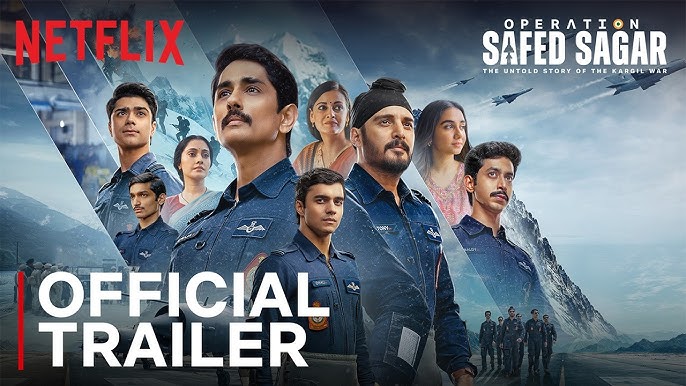
Created by Kushal Srivastava and Abhijeet Singh Parmar, the Netflix series honours the unsung Indian heroes of the Kargil War while exposing the power dynamics and internal divisions within Pakistan, without resorting to conjecture or the kind of violence depicted in Dhurandhar.

By Mayur Lookhar
Wars are undesirable – unless you are Pakistan, a nation founded on hostility towards its neighbour. In addition to a three-day armed conflict last year, Pakistan has fought four wars with India, and has supported terrorist proxies since the 1990s. Yet it has failed to achieve its stated objectives for decades. Wars are undesirable but sometimes unavoidable for a nation like India, which has consistently defended its sovereignty. Each war leaves its own mark, legacy, and lessons.
It’s been 27 years since the Kargil War of 1999, which ended in another globally recognised defeat for Pakistan. Many Indian filmmakers have celebrated Indian valour through war films, including a few about the Kargil War. Often, these films rely on conventional storytelling, portraying members of the Armed Forces as larger-than-life characters. Created by former Air Warrior Kushal Srivastava and Abhijeet Singh Parmar, Netflix series Operation Safed Sagar: The Untold Story of the Kargil War (2026) tells the untold story of the Golden Arrows – the nickname of No. 17 Squadron of the Indian Air Force.
Where it differs, though, is in how deeply it delves into the chaos on the other side through its leading characters, exposing the power dynamics and internal divisions within Pakistan’s military establishment and political system. Didn’t Dhurandhar something similar? It did, but unlike the Aditya Dhar film, Operation Safed Sagar isn’t mired in conjecture. It is less blood-soaked, indisputable, and ultimately more impactful in the context of India-Pakistan information and cultural warfare. Dhurandhar surely has got much more eyeballs, but it’s Operation Safed Sagar that the world is likely to take a serious note of. India’s action purely an act of defence while Pakistan’s duplicity lay exposed.
What kind of a nation invites a neighbour to peace talks while its military simultaneously plots an act of aggression? Well, that’s Pakistan for you. The series highlights one key difference between the two nuclear neighbours: despite Pakistan’s violation of the LoC, the Indian Armed Forces respected then Prime Minister Atal Bihari Vajpayee’s directive not to cross the LoC at any cost. Doing so would have allowed Pakistan to justify its aggression and appeal to the international community for a ceasefire, potentially resulting in India losing territory. It was a difficult challenge, one not without its share of frustration, yet the Indian Armed Forces remained determined to flush out the Pakistani intruders most of whom were disguised as mujahideen.

What’s likable about the Netflix series is how it largely stays close to reality, sticking to real names and opting for pragmatism over chest-thumping drama. Much like the Indian Armed Forces, the cast, too, is committed to respecting the chain of command. Leading from the front is Squadron Leader Ajay Ahuja, played by Siddharth, with Jimmy Sheirgill essaying the role of former Air Chief Marshal B. S. Dhanoa, affectionately called Tony by his colleagues. Adil Hussain plays Air Marshal Vinod Patney. Srivastava, Parmar, and director Oni Sen have opted for young talent to portray the Golden Arrows: Abhay Verma as the late Rajpal Singh Dhaliwal, aka Dhali; Mihir Ahuja as C. H. Bal Reddy, aka Baldy; and Harssh A. Singh as Group Captain Arvind Oak. Amrita Bagchi mesmerises you as Alka Ahuja, Ajay Ahuja’s wife, while Dia Mirza portrays Mrs. Dhanoa with grace and dignity. Prajakta Koli is a surprise choice as Madhavi, Bal Reddy’s partner.
The personal stories of the Indian Air Force officers are vital to the narrative, but it’s the drama on the other side of the border that is likely to intrigue audiences more. There’s the late General Pervez Musharraf, the architect of the Kargil War, brilliantly played by Manu Rishi Chadha. And there’s Nawaz Sharif, an iconic figure in Pakistani politics, with Vinay Pathak playing the then Prime Minister of Pakistan.

Chadha’s portrayal busts the image that the late general carefully built for himself after the Kargil War and the bloodless coup in Pakistan. In any other country, a blunder like Kargil would have resulted in its architect being court-martialled or executed. When a colleague informs Musharraf of the Prime Minister’s order to summon him, the unperturbed general tells him, “Court martial nahi, prepare for martial law.” In the years that followed, Musharraf would use his power to push through constitutional amendments and rise to become the President of Pakistan. But given the history of the Pakistani Army, every dictator eventually has to go, only to be replaced by another. The Indian series, however, reminds us that Musharraf was never held accountable for his misadventures, blunders, or abuse of power. In Pakistan, the punishment for such misdemeanour is an exile in Saudi Arabia.

While the late General presented himself as flamboyant, Oni Sen rightly portrays him as an uncharismatic figure selling a false dream to his colleagues. Many are taken aback by his vision – or the lack of it – yet couldn’t disobey their Chief of Army Staff. A classic example is the retired military officer Tauqir Zia, who was enticed by a frivolous dream of Kashmir and offered the presidency of the Pakistan Cricket Board, while his son, Junaid Zia, was also drafted into the Pakistani national team. Throughout the Netflix series, however, Oni Sen portrays Zia as a somewhat reluctant man who perhaps knew that Musharraf was leading the country towards disaster. Zia’s four-year tenure as chairman of the PCB was perhaps as disastrous as his military career.
It has always baffled us how the very man who plotted Kargil could return to initiate peace talks in India, beginning with the Agra Summit in 2001. Well, generals and dictators seldom understand diplomacy, and the Agra Summit was bound to fail. Then came 9/11, after which Musharraf and Pakistan bent to American pressure to help counter threats to the United States, but Pakistani hostility towards India did not change. Although there were no direct conflicts during this period, terrorism in Kashmir and other parts of India ruled out any possibility of peace. Musharraf, for some strange reason, became the poster boy of Pakistan and was also pursued by the Indian media after his exile to the Middle East. The Operation Safed Sagar series reminds us of the dark figure Musharraf was and the tainted legacy he left behind.

Well, military dictators rarely enjoy fanfare, but Nawaz Sharif, long seen as a key political figure inclined towards pro-India relations, is perhaps also portrayed by the Indian series as being subtly complicit in Musharraf’s Kargil blunder. The Netflix show does not demonise Sharif per se; instead, it reveals the political dynamics of a military-dominated state like Pakistan. To be fair to Sharif, however, he was unaware of Musharraf’s ulterior designs and was prepared to act against his Army Chief until his father, Muhammad Sharif – the founder of the Sharif Group – urged him to let Musharraf have his way. What does that say about Nawaz Sharif as a leader? Was he caught between his overconfident Army Chief and his father, mentor Mian Muhammad Sharif? India’s cold response to the Kashmir issue during the peace talks also upset Nawaz and compelled him to back Musharraf. The lasting image of Nawaz Sharif in the show is of a leader who secretly visits Army camps in PoK to check on the losses suffered by his troops and then blasts the senior commander there, saying, “The truth of elections is gauged from ballot boxes, and the truth of wars from hospitals. Shame on an Army that doesn’t care for its martyrs.” Director Sen and showrunners Kushal Srivastava and Abhijeet Singh Parmar still give Pakistan’s once-talismanic politician the benefit of the doubt. Let’s just say that if Dhurandhar dented the Zardaris, Operation Safed Sagar perhaps suggests that the Sharifs are not so sharif after all. Vinay Pathak, though, can hold his head high after delivering a stellar performance.
While the enemy remains exposed, Oni Sen and his writers – Sandeep Jain, Nikhil Ravi, and Barun Kashyap, do not demonise the antagonists, nor do they indulge in the kind of blood-soaked action seen in Dhurandhar. The series does not pander to institutional interests, either. There is simply no scope for “Ghar mein ghuske maarunga” narratives. On the contrary, some might argue that a certain bull-headed attitude of the then-Indian contingent in Lahore played a role in upsetting Musharraf and Sharif. The show honours our bravehearts and respects the leadership of that time, while subtly underlining the Indian Armed Forces’ frustrations, the challenges posed by limited assets, and systemic shortcomings. Well, the American role, too, is questioned. It is the overall balanced perspective that sets Operation Safed Sagar apart from the hyper nationalist cinema of the current times. The Indian Armed Forces are committed to serving the nation and placing it above everything else. No disrespect to Dhurandhar, but Operation Safed Sagar is more likely to find global acceptance, especially at a time when Pakistan appears to have gained a slight edge in the war of narratives since Trump 2.0.
Wins or losses – that is not the language of diplomacy. However, this series reminds the world that India has long been a victim of Pakistani aggression, both militarily and state-sponsored terrorism. Dhurandhar has embedded itself in the Pakistani civilian, political, terror consciousness. Now, Operation Safed Sagar should only add to the confusion and self-doubt, delivering another psychological blow to our neighbour. It might be convenient for Pakistani civilians to question the Sharifs, but would they dare to question Field Marshal Asim Munir? Well, that is Pakistan’s headache. Back home, a film on Operation Sindoor has also been announced, but with due respect, one is not sure whether Mr. Vivek Agnihotri can offer a balanced perspective comparable to that of Operation Safed Sagar.