

Ohh My Dog review: Amit Rai, his son, and his dogs – take a bhau!
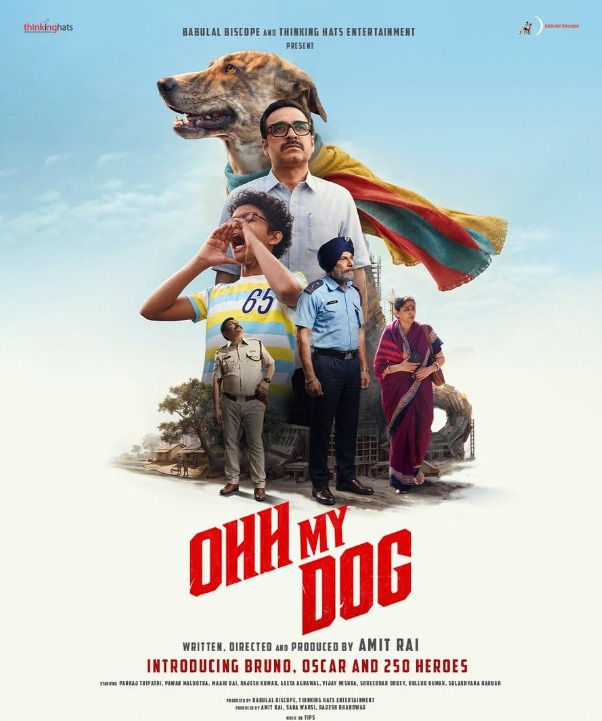
The Oh My God 2 (2023) director crafts another fine tale – one that calls for empathy toward dogs and condemns the exploitation of slumdogs.
Rating: 
 (3.5 / 5)

By Mayur Lookhar
God! When read from the right side it reads as Dog. For centuries, dog lovers have tried convincing people of the same. Unfortunately, in this man-eats-man world, can the Canis be really rewarded for their loyalty?
After leading a dignified conversation around sex education in Oh My God 2 (2023), writer-filmmaker Amit Rai now has Ohh My Dog (2026). The film opens with a state funeral for a dog called Senapati, who served with distinction. Her handler, senior cop Rajale (Jitendra Joshi), is visibly upset. His boss tries to pacify him, waxing lyrical about Senapati and her exploits, but it brings him no comfort. Rajale regrets taking her away from her pups without caring what happened to them. He tells his boss he has felt Senapati’s pain at being separated from her puppies. While a dog may be man’s best friend, can Canis say the same about man?
Story
Ohh My Dog is about a missing dog and a missing slumdog. One story is set in Assam, the other in Patna, Bihar, with the two tales running in parallel.
Apu (Maahi Rai), a smart kid from Assam is dejected at losing Momo, but is determined to find his missing pooch. In Patna, Prince (Nikhil Kumar), the son of poor labour has gone missing. His family, friends fear for his wellbeing, but it’s the community Indie dog Oscar who isn’t prepared to give up on Prince. Is Apu and the pooch though fighting a losing battle?
Screenplay & Direction
From Assam to Patna, it’s the dogged determination of Apu and Oscar that defines Ohh My Dog. The latter’s journey naturally stretches the limits of Canis, but cinema is about pushing set boundaries. It’s the adorable Oscar who makes you willingly suspend disbelief at his dogged effort.
Two ‘search’ stories run in parallel, but the core is the same: Dharmo Rakshati Rakshitah (Dharma protects those who protect it). The film condemns gluttony and greed, and makes a quiet plea for kindness to dogs and other animals, while decrying the exploitation of slumdogs.

In a nation of 150 crore people, it’s hard to care for animals, especially since most people struggle to make ends meet. At the end of the film, Rai makes a plea: if you can’t show kindness, then at least do no harm to animals. PETA and animal-welfare bodies have existed for decades, but a few bad experiences – dog bites, even few fatalities – have seen aggrieved citizens hit back at animal lovers and raised concerns over human safety. It’s here that Rai plays it smart: while his dogs bark, none bite – not even at the evil men who exploit their kind.
Animal welfare, exploitation is a subject that’s been explored recently with films like Lakadbaggha (2023), Pariah (2024). Though well made, well intended, the creators of these films have unleashed the anger against human greed, which perhaps made them a difficult watch for some. Ohh My Dog has a similar tension, but stays clear of any cruelty.
From OMG 2 (2023) to Ohh My Dog, faith is integral to Amit Rai’s films – but it isn’t used to propagate doctrine. It’s simply a source of strength and clarity from the Almighty to tackle the conflict at hand. The journeys to Assam and Patna are each filled with their own cultural reflections.
Having set out the two respective agendas very early, Rai has the audience hooked on to the two search operations. The search for Momo is more pragmatic, whereas Oscar’s search for Prince hinges more on a leap of faith. There are moments when the action, or the lack of it, might make it feel stretchy, but Ohh My Dog largely keeps you on the edge of your seat. Credit goes to Rai’s fine writing, astute direction, and gifted cast, both human and mammal.
Acting

Ohh My Dog is Amit Rai’s third directorial in 17 years. He clearly prioritises quality over quantity, and actors over stars. Pankaj Tripathi, who brilliantly led OMG 2, is happy to take a back seat and let a 14-year-old boy and a dog run the show. Naturally, Tripathi’s conflict lies in Bihar, where his Masterji character takes an active role in the search for Prince. The acclaimed actor’s understated demeanour works perfectly in a place, and a system – where it’s difficult for a common man to raise his voice.
That leaves the film on the shoulders of child artiste Maahi Rai, who is also the director’s son. Momo, the pooch whose real name is Oscar, is the Rai family pet. With a name like Maahi, the boy perhaps ought to do great things.

Apu, pronounced Opu by his Assamese mother, is mature beyond his years as he leads the search operation for his pet. Hey, isn’t that the job of the police? Well, that is enough to make you question the competence of the local police. Lately, Gen Z and Gen Alpha have seized the nation’s imagination by questioning the competence of the establishment and demanding accountability.
Apu is a humble boy who relies on his tech savviness to search for his missing dog. We lament children’s excessive use of phones for PUBG, Reels and social media, but boys like Apu also deserve respect for making constructive use of technology.
It isn’t Maahi’s IQ or tech savviness alone; he also backs these qualities with the right intensity and emotional quotient to play Apu. In a precarious situation, time is of the essence, and Apu isn’t prepared to lose his Momo. This naturally leads to tense moments, first with SHO Md. Yusuf Hazari and later during his arguments with the honest senior RTO officer Sodhi (Pavan Malhotra). For the audience, though, these heated arguments make for good banter. Maahi’s strong performance speaks volumes about his budding talent, and let’s hope he only gets better with age. One thing is certain: after watching this film, people are likely to consult Apu on how to track missing pooches and phones.

From a near-super boy, we now have a super dog in Oscar, whose real name is Bruno, who displays ultimate doggedness in his quest to find his prince. How do you sum up Oscar’s performance? Well, in the annals of cinema, this rescue act by a canine is worthy of an Oscar. Rai demands a great deal from his four-legged protagonist. The striped indie mixed-breed, though, is happy to run for miles through the streets of Patna. Given the technology presumably involved, the emotions Oscar displays look remarkably natural. Credit goes to Rai and Bruno’s handlers, along with a huge shout-out to cinematographers Máté Herbai and Karandeep Singh for pulling off the herculean task of capturing Bruno and the other canines on camera.

The police force is often cinema’s whipping boy. The recent events at Jantar Mantar and in Bihar have done little to improve its public image. SHO Md. Yusuf Hazari lives up to that image. We wonder whether it is convenient for Hazari to be apathetic towards dogs. In his first scene, Hazari reduces Apu’s mother to tears by reminding her that certain tribes have dogs on their menu. Yet the relatively unheralded Vijay Mishra delivers a tour de force -a career-defining performance. In Bihar, it is the seasoned Rajesh Kumar’s Daroga who is perhaps the greater evil. Interestingly, Rai chooses to refer to him simply as Daroga (cop). Even while committing corrupt acts, Kumar’s character continues to amuse us with his antics.
The tale set in Bihar speaks of the misfortunate of the have-nots, and Rai is smart in casting rustic faces rooted in the land, the caste system and labour. This is an India that mainstream Bollywood seldom cares about, but its stories and struggles can no longer go unnoticed. Perhaps Rai needed slightly greater conviction from the actors portraying the impoverished characters, particularly Prince’s father and mother.

Geeta Agrawal Sharma was a revelation in Ohh My Dog, but the Assamese accent weighs heavily on her performance here. Assamese actor Sulakhyana Baruah makes her Bollywood debut with Ohh My Dog. Her character, Krishna, is intriguing. Born to an Assamese father and a Sikh mother, she is the niece of Sodhi (Pavan Malhotra), who still hasn’t forgiven his sister for marrying outside the community. Simply having Krishna around perhaps strengthens Apu’s resolve. She is a calming presence amid the heated arguments between Sodhi and Apu. Baruah impresses in her Bollywood debut
Pavan Malhotra has been a regular presence in Amit Rai’s films, and the seasoned actor shines once again. His Sikh character comes with a certain stereotype and rigidity, dismissing Apu as piddhi (small), yet he is perhaps the most honest cop in Assam. Let’s not forget that the late former Prime Minister Dr Manmohan Singh made Assam his second home.
Music and technical aspects
A life-and-death situation usually warrants serious drama, but Rai and composer Aman Pany score a couple of fine tracks, Sone Do and Dharma. It is Mangesh Dhakde’s background score, though, that serves as the heartbeat of the film. As the tension soars, so does the intensity of the BGM. In Assam, Dhakde taps into the sounds of the Karbi bamboo dance, while in Patna, he uses a dog’s panting to match the rising tension. Capturing Oscar, Momo and the other canines was just one of the difficult tasks faced by Máté Herbai and Karandeep Singh, but these cinematographers also ably support Rai’s visual storytelling.
Final thoughts
Given the challenges involved in making an animal-led drama, the genre has remained largely untapped in Hindi cinema. Haathi Mere Saathi (1971) and Teri Meherbaniyan (1985) have long served as benchmarks, but Ohh My Dog now sets a new pedigree. Amit Rai, his son and his dogs – take a bhau.
Video review to follow.