

Maa Behen review: Daayan nahi, devi hai
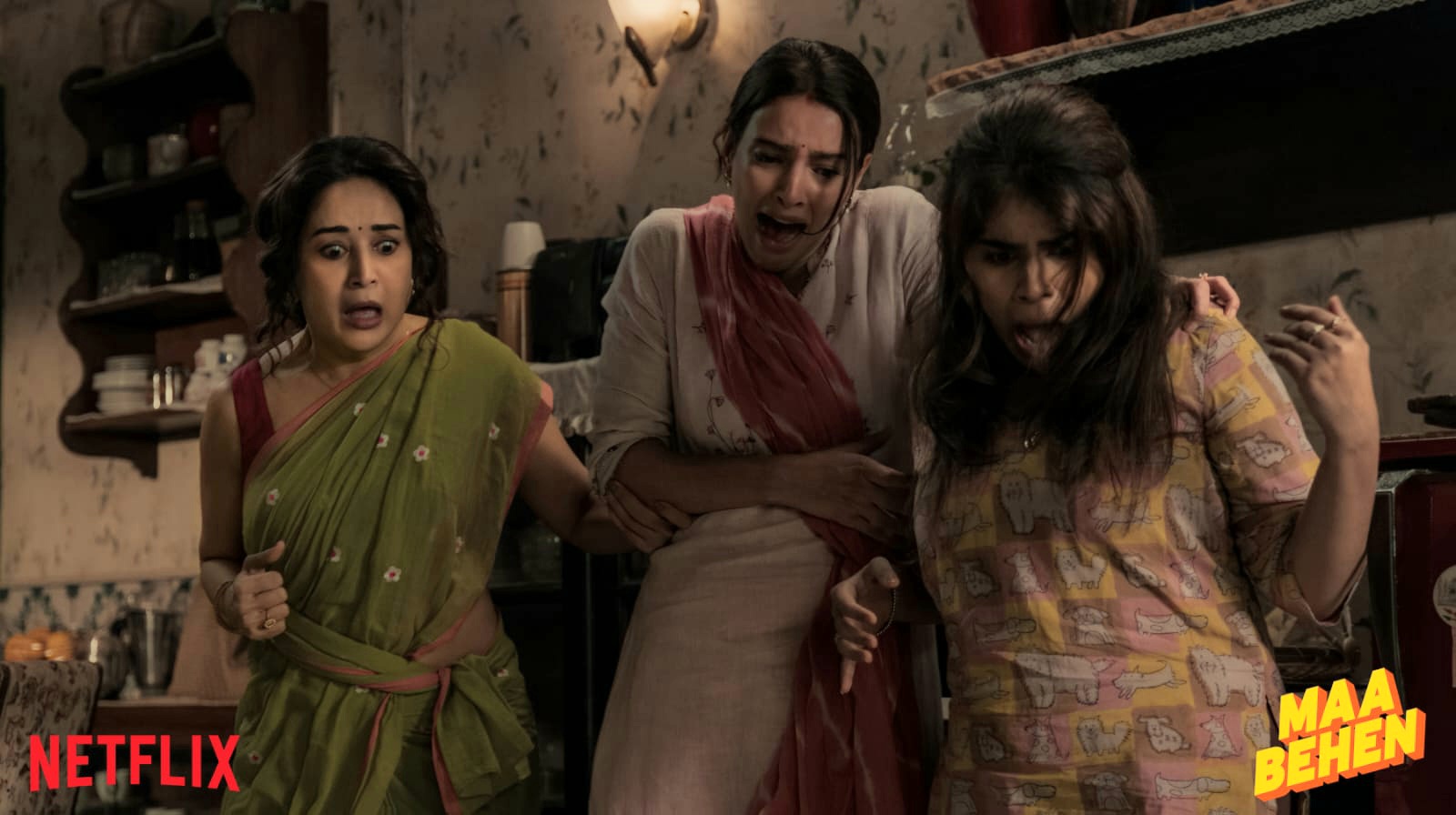
Writer Pooja Tolani and director Suresh Triveni’s dark comedy explores how a conservative society views a maa-behen household. Madhuri Dixit reinvents herself with a Bihari character, Triptii Dimri delivers another tour de force, and young Dharna Durga emerges as a firebrand.
Rating: 
 (3.5 / 5)

By Mayur Lookhar
In the dark days of cinema, when a lecherous villain laid his hands on an innocent woman – often a sister or a village belle, the victim would plead, “Chhod do mujhe, tere ghar maa-behen nahi hai kya?” (Please let me go. Don’t you have a mother-sister at home?). What was meant to resist sexual violence was, over time, reduced to a source of humour for audiences and society at large. Filmmakers, too, seemed to absorb this shift, perhaps treating such cruelty as part of formulaic entertainment. The term ‘maa-behen’ also became a slang, often used as a threat.
So, when a film titled Maa Behen comes along, slangsters are bound to have a field day. For us, though, this cleverly crafted title conveys the writer’s thought behind it. This will be a film that shows us how a conservative society looks at a maa-behen household and a challenge for this family to earn basic respect.
Story
One dark night, half-siblings Jaya (Triptii Dimri) and Sushma (Dharna Durga) get a panic call from their mother Rekha (Madhuri Dixit), who reveals that their neighbour Gupta ji (Ravi Kishan) has passed away. The siblings question why that should bother them, and then Rekha drops the bombshell: he died in our house. The next morning, the half-siblings arrive and hear a story from their mother. Is that how things really transpired? Soon, Jaya’s chauvinist husband Manas (Shardul Bhardwaj) arrives, further complicating things for the maa and behen.
Screenplay & Direction
Director Suresh Triveni is known for his strong feminist films. However, it would be premature to place Maa Behen in the same bracket, as this story should prompt everyone to introspect, regardless of gender. Triveni is said to have conceived the initial idea some five or six years ago. Writer Pooja Tolani then co-developed the idea, which eventually culminated in Maa Behen.
As stated earlier, the vision behind the story is to explore how a conservative society perceives a family comprising a single mother and two daughters – one who barely saw her father, the other a half-sibling who still doesn’t really know her biological father. The primary region is unspecified, but the tone suggests that this tale is set in the hinterland. Triveni and Tolani do not hide the fact that Jaya resides in Patna. The region, however, is immaterial as prejudices exist more in the mind. And it’s this mind that Maa Behen exposes. Kuch toh log kahenge, logon ka kaam hai kehna (People will always have something to say; it’s their nature). More critically, Maa Behen shows how outside noise shapes beliefs and relationships in a maa-behen household, eventually resulting in a dysfunctional family.
Though largely well-written, Maa Behen has its stretchy moments, but its quality cast and well-etched characters ensure consistent engagement. The brilliant climax and the performances make it an uplifting experience.
Acting

Hema, Rekha, Jaya aur Sushma, sabki pasand Nirma! Suresh Triveni, a former adman, has drawn on the classic detergent ad to create his lead characters. Madhuri Dixit isn’t new to a Bihar setting, having played one in Prakash Jha’s Mrityudand (1997) , but it’s perhaps the first time that she’s attempted the Bhojpuri accent. She isn’t quite convincing to begin with, but Triveni doesn’t burden his protagonist with the dialect, thus freeing Dixit, who engages the audience more with Rekha’s story.
The character arc adds intrigue around Rekha, perhaps lulling the viewers into forming opinions just like the people in her vicinity. Having lost her husband and mother-in-law in a freak accident, and then a surprise second pregnancy had seen Rekha being labelled a daayan (witch) by residents of Adarsh colony. The personal loss and the character name sprang back memories of a yesteryear star being subject to a witch-hunt after her husband died by suicide. What shocked back then was how certain eminent figures from the film industry added to the witch hunt. Dixit emotes Rekha’s similar pain. It’s all the more aggravated as her children, too, are judged harshly. Honestly, Rekha, Jaya, and Sushma – each one of them have their flaws and made decisions that kind of added to the rumours around them.
Watching Dixit in this avatar, it’s kind of also calls upon us fans to move over from the Dhak Dhak or Ek, Do, Teen fixation. It feels bizarre when Gen Z or millennials refer to her as the Dhak Dhak girl. Some young anchors frivolously call her an eternal crush. Honestly, fans who are around the same age as Madhuri are likely to be less flattering. Dixit’s been around for over three decades, married for 27 years, and her boys have grown into adults. Films like Maja Ma (2022) and Maa Behen have helped Dixit reinvent herself in more mature roles, and shouldn’t we fans now respect her for what she is now?
Jaya is required to share a cold relationship with Rekha, and Triptii Dimri doesn’t let her fanfare come in the way of another tour de force performance. Dimri has a better grip on the dialect too. The daughter thought marriage and having a child would help her find meaning in life and have a functional family, something she hasn’t quite experienced since losing her father. How, in the name of escapism, we often end up attracting more misery, more pain. Jaya’s marriage feels like bondage, serving not just her husband but also her very demanding in-laws. She’s even counted the number of rotis she’s baked for this greedy Sinha family. Then she suspects her sister of being in an illicit relationship with her husband. Jaya, however, isn’t prepared to go back to her previous life. Add to it the extraordinary circumstances that surround her maternal home, and Jaya feels caught between a rock and a hard place.

Dharna Durga is an influencer, and her character Sushma is one in the film too, but this doesn’t appear to be a casting based on social media following. Pin that down to Durga’s enormous talent. The suspense around her father adds to the half-sibling rivalry and also makes Sushma more bitter in her conversation with her mother, Rekha. Durga completely submits herself to the world of Sushma and emerges as a firebrand.
There is more than one dysfunctional family here, and the Gupta family is the most broken. It’s brave of Ravi Kishan to take on this role at a time when his stock has risen thanks to memorable characters in films like Laapataa Ladies and Son of Sardaar 2, and the series Maamla Legal Hain. Best to discover more about Gupta ji for yourself, but this is another flawless act by Kishan.
Geetanjali Kulkarni easily slides into the role of Guptain (Mrs. Gupta), a woman who dislikes Rekha and her daughters. Much of it is down to envy, but Mrs. Gupta is a creation of patriarchy too. She is presented as a henpecker, but is she really one? Maybe it’s limited to the corridors of her house, because outside the house, Gupta Ji did as he pleased. Here is a woman who has so much anger, and maybe it’s taken its toll on her health, as evident from her limp – something said to be an impromptu act but adding value to the character.
Then there is a dopey son, who seems least bothered about his father’s disappearance and caring little for his sister Hema aka Goldie’s wedding. As a child, Hema (Rrama Sharma) had her run-ins with Jaya and Sushma. On one occasion, she lost her two teeth, but her parents got her two gold teeth, hence the nickname Goldie. You really feel for this young girl, who clearly has no voice, low self-esteem, and the family sees a wedding as the means to dispose of her. Young Rrama Sharma, though, is a breath of fresh air.
Shardul Bhardwaj is impressive in his chauvinist character Manas. The one who takes the cake here, though, is popular crime show anchor Shrivardhan Trivedi, who gets to play himself, as Triveni uses him to televise all the gossip around Rekha, Jaya, and Sushma. In a film where the men are largely chauvinists, Arunoday Singh’s Inspector Maheshwari is somewhat difficult to predict. He crushed on Jaya, and maybe still does, but then he is also duty-bound to find his missing brother-in-law, Gupta Ji.
Music & Technical Aspects
A black comedy doesn’t necessarily warrant playback music, but Triveni and composer Akashdeep Sengupta offer a few memorable tunes. Bhojpuri cinema and music have a penchant for Kaari Kaari, as reflected in various versions. Popular Bhojpuri singer Neelkamal Singh contributes one of his own here. Then there’s Khol Pinjara, crooned by Akashdeep Sengupta and Pooja Tiwari, which has the vibe of a Shankar Mahadevan classic. Dhak Dhak Reloaded was perhaps used as a promotional song.
Triveni’s previous film, Subedaar (2026), marked his maiden foray into hardcore action, a genre he approached with unflinching visual boldness. With Maa Behen, Triveni ventures into dark comedy, adopting a correspondingly darker tonal and visual palette.
Final Word
After all the chaos, madness, swearing, and humour, Maa Behen leaves you entertained yet contemplative. What makes it special is this: while it exposes prejudices and slandering, it preaches nothing. It simply leaves it up to the viewer to respect personal spaces. And at the end of it all, Rekha, Jaya, and Sushma emerge as devis – not daayans.
Video review to follow.